
Cox flexion-distraction.
Room for the nerve.
Most chiropractic offices in Los Angeles do not have one. Here it is the first thing we reach for when a disc or a nerve is involved, and it does work that hands alone cannot.
Who ends up on this table
Most people who end up here arrive with a version of the same story. The pain is not only in the back or the neck. It travels. It runs down a leg or into an arm, it changes depending on how you sit or stand, and it has not let up with rest, stretching, or the advice you have already been given.
That pattern usually points to a disc or a nerve root, and that is the exact situation this table was built for. If your exam points there, you will spend part of most visits on it.
What it actually does
A herniated or bulging disc is, mechanically, a pressure problem. Disc material has moved where it does not belong and is pressing on or chemically irritating a nerve root. Take the pressure off and the nerve has a chance to calm down.
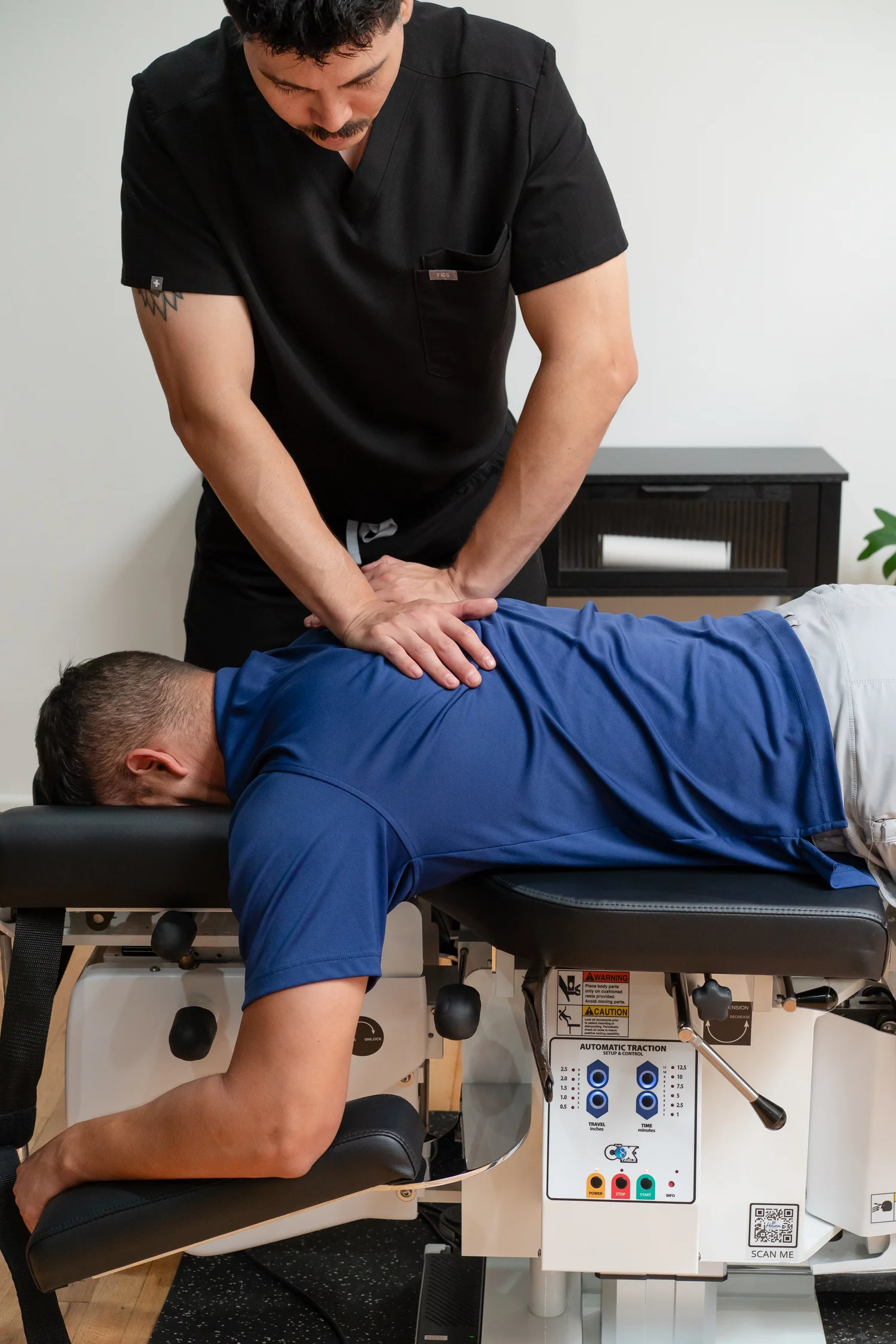
The table does that mechanically rather than manually. You lie face down. The doctor contacts one specific spinal segment by hand while the lower half of the table drops and moves in a slow, controlled cycle. That combination opens the level being treated instead of loading it.
Two things follow from that. The opening where the nerve root exits the spine gets wider, which means less contact and less irritation. And the pressure inside the disc itself drops, which matters because a disc has almost no blood supply of its own and depends on pressure changes to move fluid, nutrients and waste in and out.
What does not happen is equally important. No thrust, no rotation, and no force delivered into the injured level. That is the entire design intent: a way to treat an angry disc without provoking it.
What it feels like
Slow and rhythmic. Most people describe a stretch through the low back, or a pulling sensation down the leg that eases as the session goes on.
It should not hurt. If a position sharply reproduces your symptoms, that is information, and we change the setup. There is no cracking sound and no sudden movement at any point.
People who are nervous about being adjusted, and people who have been told by another provider not to be, are usually comfortable on this table.
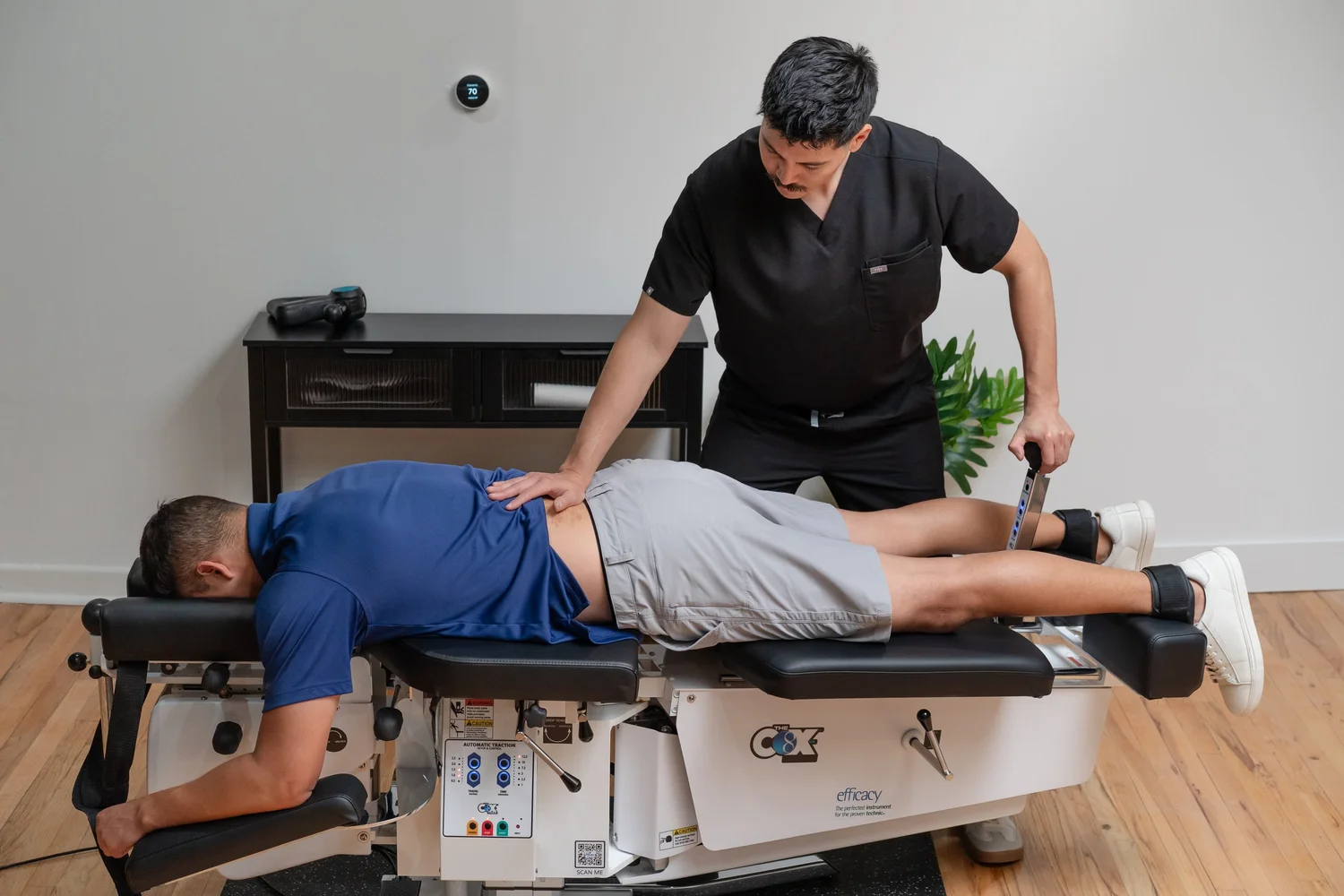
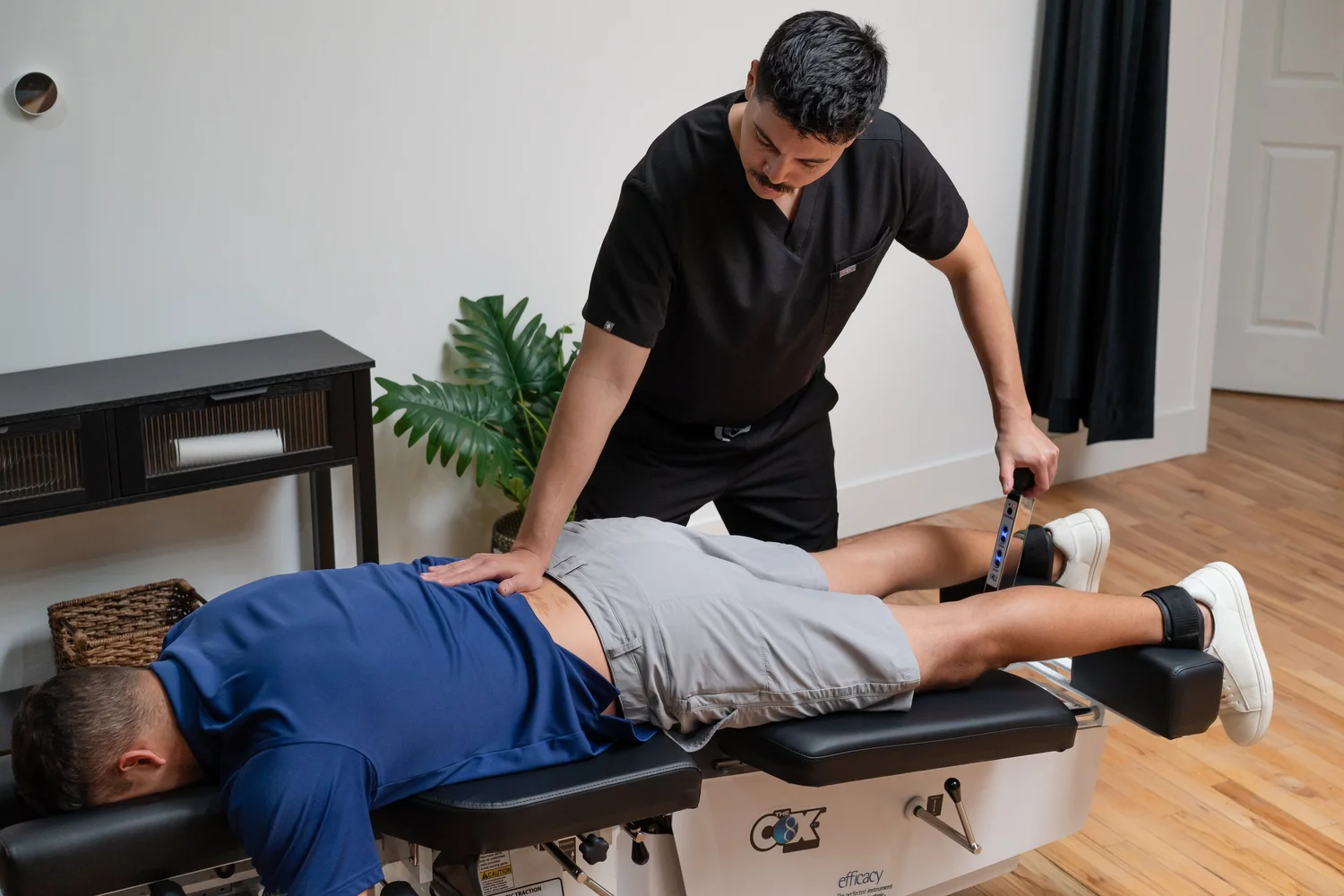
The table opens the level. It does not push on it.
What it does for your problem
Disc herniation or bulge
This is the problem the technique was designed for. Decompression at the involved level, repeated across a course of visits, is aimed at reducing contact between displaced disc material and the nerve root while the disc has a chance to settle.
It is also one of the few conservative approaches studied specifically on disc pathology rather than on back pain in general.
Sciatica
Sciatica is a symptom, not a diagnosis, and the table only helps when the cause is a disc or a narrowed opening the nerve passes through. That is why the exam comes first.
When testing points to a disc or to stenosis, flexion-distraction addresses the compression directly. When it points to the piriformis or the SI joint instead, this is the wrong tool and we will tell you so rather than putting you on it anyway.
Pinched nerve in the neck
The same principle applies to the cervical spine, with the doctor supporting your head and neck and distracting the level that is involved.
For arm pain, numbness, tingling or weakness coming from a compressed cervical nerve root, this is generally better tolerated than a rotational adjustment, and it lets us treat the level directly without twisting through it.
When it is not the right call
Flexion-distraction has a good safety record, but it is not for everyone, and we screen for that before you ever get on the table.
Signs of cauda equina compression, progressive neurological loss, suspected fracture, segmental instability, certain post-surgical hardware and some bone conditions all rule it out. If any of those turn up in your history or your exam, you get referred rather than treated. That is the reason the assessment always comes first.
How it fits into your care
The exam comes first. If the findings point to a disc or a nerve, you are on the table the same day rather than being booked back for it.
Disc and nerve cases are usually seen more often early on and tapered as symptoms settle. You get a specific projection after your exam, not an open-ended plan.
Soft tissue work first, to release the muscles guarding the segment. Rehab after, to hold the change. The table on its own is not a treatment plan.
Find out if the table is right for you
Your first visit is 60 minutes: full history, orthopedic and neurological testing, and hands-on treatment the same day. If the exam says the table is the right tool, we start there.
Book your first visit →5478 Wilshire Blvd, Unit 212 · Los Angeles, CA 90036