
Sciatica is a symptom.
Not a diagnosis.
Sciatica just means your sciatic nerve is irritated somewhere along its path, it doesn’t explain why. And without knowing why, treatment is a guess. This page explains what sciatica actually is, what causes it, and what a proper assessment looks like.
9 minute read.
What is sciatica?
Sciatica refers to pain, numbness, tingling, or weakness that travels along the path of the sciatic nerve — from the lower back, through the buttock, and down the back of one leg. It’s one of the most common pain complaints in the world, and one of the most frequently misunderstood.
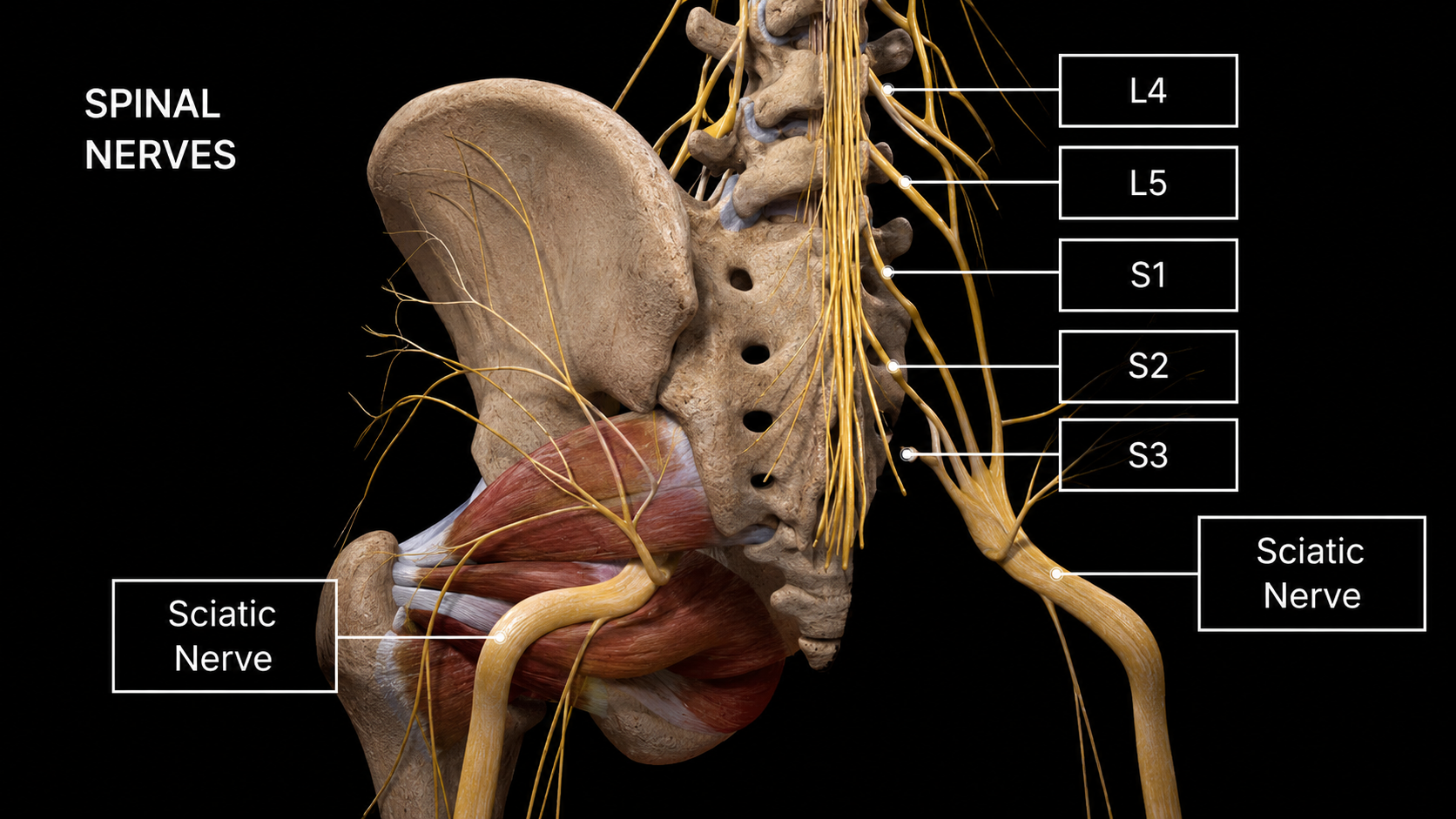
The sciatic nerve is the largest nerve in the human body. It forms from nerve roots at the L4, L5, S1, S2, and S3 levels of the lumbar spine, travels through the pelvis, and runs down the back of each leg all the way to the foot. When any part of that nerve — or the spinal nerve roots that feed it — gets compressed, irritated, or inflamed, you feel it somewhere along that entire path.
That’s why sciatic pain shows up in such unexpected places. The problem is in the lower back or deep hip. The burning is in the calf. The numbness is in the foot. The nerve is the messenger — it’s telling you something is compressing it upstream. Treating the leg where the pain is felt won’t resolve sciatica. Finding and addressing what’s compressing the nerve is what does.
According to NIH’s StatPearls, sciatica has a lifetime incidence of 10–40%, with peak onset in the fourth decade of life. There is no gender predominance — it affects men and women equally. And despite being extremely common, it is frequently undertreated or misdirected because the underlying cause isn’t properly identified.
What actually causes sciatica
Lumbar disc herniation (Most common)
The most frequent cause of sciatica. When a disc herniates at L4-L5 or L5-S1, the displaced disc material can press directly against the nerve root as it exits the spinal canal. The result is chemical irritation and mechanical compression of the nerve producing the burning, shooting, or electrical pain that runs down the leg.
Disc-driven sciatica is typically worse with sitting, forward bending, or increased abdominal pressure (coughing, sneezing). It usually originates in the low back before radiating down and often extends past the knee into the calf, foot, or toes. Neurological changes like reflex loss, dermatomal numbness, or muscle weakness are more common in disc cases than in other causes.
Key research: Lumbar disc herniation accounts for the majority of true sciatica presentations.
Piriformis syndrome
The piriformis is a small but important muscle deep in the buttock that externally rotates the hip. The sciatic nerve runs directly beneath it and in some people, actually through it. When the piriformis becomes tight, inflamed, or goes into spasm, it can compress the sciatic nerve and produce symptoms that feel exactly like disc-driven sciatica.
The difference: piriformis syndrome typically starts in the buttock rather than the low back, rarely extends below the knee, and worsens with hip rotation movements rather than spinal loading. Low back pain is often absent. Standard MRI won’t show it which is one reason it’s missed when clinicians rely too heavily on imaging and not enough on examination.
Key research: Estimated 6% of sciatica cases are piriformis-driven. Female-to-male ratio approximately 6:1.
Spinal stenosis (Common in older adults)
Spinal stenosis is a narrowing of the spinal canal that compresses the nerve roots within it. Unlike disc herniation, which tends to compress a single nerve root at one level, stenosis often affects multiple levels and produces a more diffuse pattern of leg symptoms. It’s more common in patients over 50 and is associated with progressive degenerative changes in the spine.
Key research: Stenosis and disc herniation produce overlapping but distinguishable symptom patterns.
Sacroiliac joint dysfunction (Often under diagnosed)
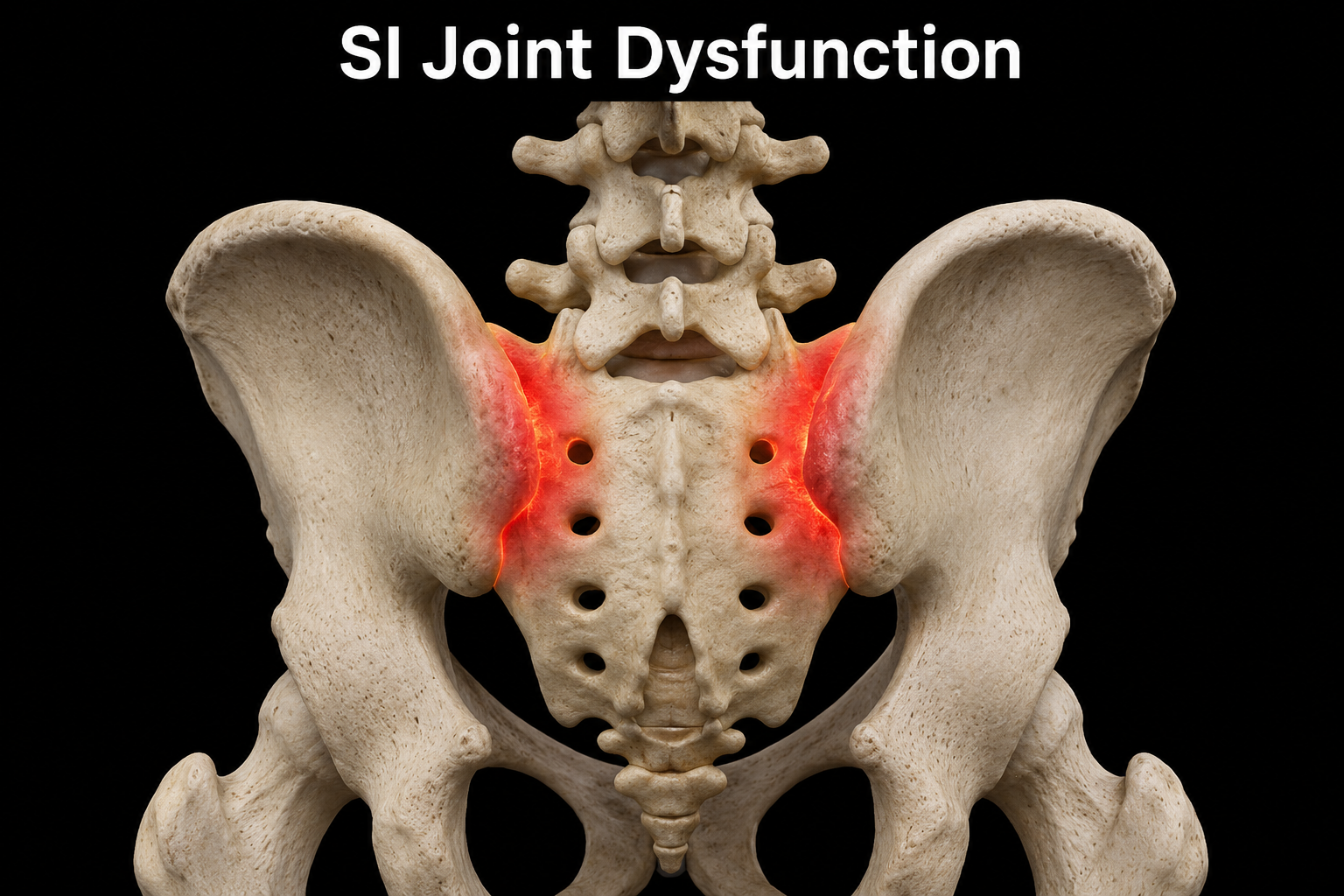
The sacroiliac (SI) joint connects the base of the spine to the pelvis. When it becomes dysfunctional, either too mobile or too restricted, it can refer pain into the buttock, posterior thigh, and occasionally the leg in a pattern that closely mimics sciatica. SI joint dysfunction is estimated to account for 15–30% of chronic low back pain cases, yet it is frequently mistaken for disc herniation.
The reason it gets missed: standard MRI and X-ray findings are often normal even when SI joint dysfunction is the actual pain source. Diagnosis relies on clinical examination using specific SI joint provocation tests, not imaging. A patient treated for disc herniation when the true driver is SI joint dysfunction will not improve, regardless of how consistent they are with treatment.
Key research: SI joint dysfunction accounts for 15–30% of chronic low back pain and frequently mimics disc and sciatic pain on imaging.
What sciatica feels like and how to start reading the pattern
Sciatica presents differently depending on what’s causing it. The location, quality, and behavior of your symptoms carry clinical information before anyone examines you.
Common descriptions of sciatic pain include burning, shooting, electric, stabbing, or aching sensations that travel down one leg. Numbness and tingling are common. Weakness in the leg or foot, difficulty standing on your toes, or a foot that feels heavy and hard to lift, indicates more significant nerve involvement. Pain is almost always one-sided.
The behavior of your pain gives strong clues about the driver. Disc-driven sciatica typically worsens in positions that increase spinal loading, like sitting, forward bending, prolonged standing. It often feels better when walking or lying down with the knees bent. Piriformis-driven sciatica worsens with activities that rotate or load the hip like sitting on hard surfaces, climbing stairs, crossing the legs. Stenosis-driven sciatica classically worsens with walking and standing, and relieves with sitting or bending forward.
Pain drivers:
-
Pain originates in the low back and radiates down the leg often past the knee
Worsens with sitting, bending forward, coughing or sneezing
Often extends below the knee into the calf, foot, or toes
May include reflex changes, dermatomal numbness, or leg weakness
MRI may show disc herniation or foraminal narrowing at corresponding level
-
Pain starts in the buttock or hip, may not involve the low back at all
Worsens with hip rotation, prolonged sitting on hard surfaces, climbing stairs
Usually limited to buttock and posterior thigh rarely below the knee
Neurological findings typically absent or mild
MRI often appears normal even when SI joint or piriformis is the driver
These patterns are starting points, not definitive answers. Presentations overlap. Some people have disc herniation and piriformis involvement simultaneously. Some have SI joint dysfunction on top of a disc finding on MRI that isn’t actually causing their pain. That’s exactly why a proper clinical assessment is necessary.
When sciatica requires urgent medical attention
Most sciatica is a musculoskeletal problem that responds to conservative care. But certain presentations indicate something more serious that requires immediate medical evaluation not conservative treatment.
Progressive leg weakness that is getting worse over days, not just pain, but actual loss of muscle function
Loss of bladder or bowel control, or difficulty initiating urination
Numbness or tingling in the groin, inner thighs, or perineal area (saddle anesthesia)
Bilateral leg symptoms: pain, numbness, or weakness in both legs simultaneously
Sciatica that developed following significant trauma or in someone with a known history of cancer
These signs may indicate cauda equina syndrome or another serious pathology requiring surgical or emergency evaluation. If you are experiencing any of these symptoms, go to an emergency department or contact your physician immediately. Do not wait for a chiropractic appointment.
FAQs
The most common questions we hear from people before their first visit.
-
Sciatica refers to pain, numbness, tingling, or weakness that travels along the path of the sciatic nerve — from the lower back, through the buttock, and down the back of one leg. It is a symptom, not a diagnosis. The sciatic nerve forms from nerve roots at L4, L5, S1, S2, and S3 in the lumbar spine and runs all the way to the foot. When something compresses or irritates the nerve or its roots, you feel it somewhere along that path — which is why the pain often shows up in the calf or foot even though the problem is in the lower back or hip.
-
Sciatica has several distinct causes. The most common is lumbar disc herniation — when a disc at L4-L5 or L5-S1 presses against a nerve root. Other causes include piriformis syndrome, lumbar spinal stenosis, and sacroiliac joint dysfunction. Each cause produces a different pattern of symptoms and requires a different treatment approach. Getting the diagnosis right is essential and treating disc herniation when the actual driver is piriformis syndrome will not produce improvement.
-
Proper sciatica diagnosis requires clinical history, neurological testing, orthopedic provocation tests, and imaging review together — not any one in isolation. Neurological testing includes reflex testing, dermatomal sensation mapping, and myotomal strength assessment. Orthopedic tests such as the straight leg raise, Slump test, FAIR test, and SI joint provocation tests identify the structural driver. MRI must be reviewed alongside clinical findings — studies show 64% of people with no back pain have disc abnormalities on MRI, meaning imaging alone cannot determine the cause.
-
No. A landmark study in the New England Journal of Medicine found that 64% of people with no back pain had at least one disc abnormality on MRI. A disc finding does not automatically mean it is causing your pain. Conditions like piriformis syndrome and sacroiliac joint dysfunction, which both produce sciatica-like symptoms, often appear completely normal on MRI. Clinical examination alongside imaging is what produces an accurate diagnosis.
-
Disc-driven sciatica originates in the lower back and radiates past the knee into the calf, foot, or toes. It worsens with sitting, forward bending, or coughing. Piriformis syndrome starts in the buttock, rarely extends below the knee, and worsens with hip rotation movements. Low back pain is often absent in piriformis syndrome. Standard MRI will not show piriformis syndrome, which is one reason it is frequently missed when clinicians rely on imaging rather than physical examination.
-
Sometimes, but less often than people expect. A prospective cohort study tracking 622 patients found that 55% still had sciatic symptoms two years after onset, and 53% at four years. Cases with confirmed nerve compression, significant neurological findings, or symptoms persisting beyond 6 to 8 weeks consistently do better with structured conservative care than with watchful waiting alone.
Ready to find out what’s actually going on?
Your NERV Origin. 60 minutes.
A real answer. Treatment on day one.
Full assessment, imaging review, and hands-on treatment in a single visit. You leave knowing what’s driving your pain, what the plan is, and already feeling the difference. New patients only.