
Where it goes numb.
Tells us which nerve.
Numbness, tingling and weakness are not random. Every nerve root in your spine supplies a specific patch of skin and a specific set of muscles, so what you have lost, and exactly where, points back at the level causing it.
Two people say the same sentence
Both of them say their arm is going numb. One means the thumb and index finger. The other means the ring and little finger. Those are different nerve roots, two levels apart in the neck, and they do not get the same treatment.
This is why the first question in an exam is not how bad it is. It is exactly where it is. A patch of numbness has an address, and the address narrows a long list of possibilities down to a short one before anyone touches you.
The same logic runs down the leg. Numbness across the top of the foot and into the big toe is a different level than numbness in the back of the calf and the outer heel, even though both get described as sciatica.
Where do you feel it?
Pick the area that matches yours. Numbness and tingling follow the nerve root they come from, so where you feel it narrows down where the problem is.
Choose an area above and the nerve root it points to will show here.
These patterns overlap and vary between people, and published dermatome maps disagree with one another more than most charts admit. This narrows the list. It does not replace an exam.
What a dermatome is
A dermatome is the area of skin supplied by a single spinal nerve root. You have 31 pairs of spinal nerves, and each one takes responsibility for a territory. Stack those territories together and they cover the whole body.
On the trunk they run as roughly horizontal bands, which is why landmarks are easy there. The nipple line sits at T4, the bottom of the ribcage around T6, the navel at T10. On the arms and legs they do not run as bands at all. They run as long stripes down the length of the limb, because limbs grow out as buds during development and take their nerve supply with them as they rotate. That is why L5 runs unbroken from the buttock down the outside of the leg and across the top of the foot.
Myotomes, and why strength gets tested too
A myotome is the same idea applied to muscle. It is the group of muscles driven by a single nerve root. Sensation and strength are two separate signals coming from the same place, which is why the exam checks both.
Most of these tests look unremarkable from the outside. Walking on your heels tests whether L4 is driving the muscles that lift the foot. Walking on your toes tests S1. Squeezing a hand tests C8. Spreading the fingers tests T1. None of it is dramatic, and all of it is specific.
Lifting the arm out to the side. Weakness shows up as an arm that drifts down when you hold it there.
Bending the elbow and cocking the wrist back. Carrying a bag or holding a steering wheel gets tiring.
Straightening the elbow. Pushing a heavy door, or pressing up out of a low chair.
Closing the hand. Grip fades, jars get harder, and things slip out without warning.
Pulling the foot upward. Heel walking is difficult and the foot can slap down when you land.
Lifting the big toe. The toe starts catching on the ground, and in time the foot can begin to drop.
Pushing the foot down. Rising onto the toes on that leg alone is weak, and push-off disappears when walking.
The chart narrows the list.
The exam is what decides.
Why a chart is not a diagnosis
Dermatome maps are drawn as though the boundaries are clean. They are not. Adjacent levels overlap substantially, the territory varies from person to person, and the major published maps genuinely disagree with each other. The two most widely reproduced versions were built from different methods decades apart and do not match. Most charts leave that out.
Then there is the problem of lookalikes. Numbness in the thumb and index finger fits C6 in the neck, and it also fits carpal tunnel at the wrist. Numbness down the outside of the leg fits L5, and it also fits a nerve being compressed by muscle much further down. Same complaint, different cause, different treatment.
What separates them is testing one structure at a time to see which reproduces your symptoms, checking sensation against strength, and comparing both sides. The map tells us where to look. It does not tell us what we will find.
When numbness needs an emergency room
Most numbness is not an emergency. A small number of patterns are, and they are worth knowing by name because waiting on them causes permanent damage.
- Numbness across the groin, inner thighs or buttocks, the area that would touch a saddle
- Any new change in bladder or bowel control, including difficulty starting or not feeling it happen
- Weakness in both legs, or weakness that is getting worse by the day rather than the month
- Numbness or weakness that follows a significant fall or collision
Those need emergency care the same day, not an appointment. Everything else on this page can be worked up properly in an office.
Find out which nerve
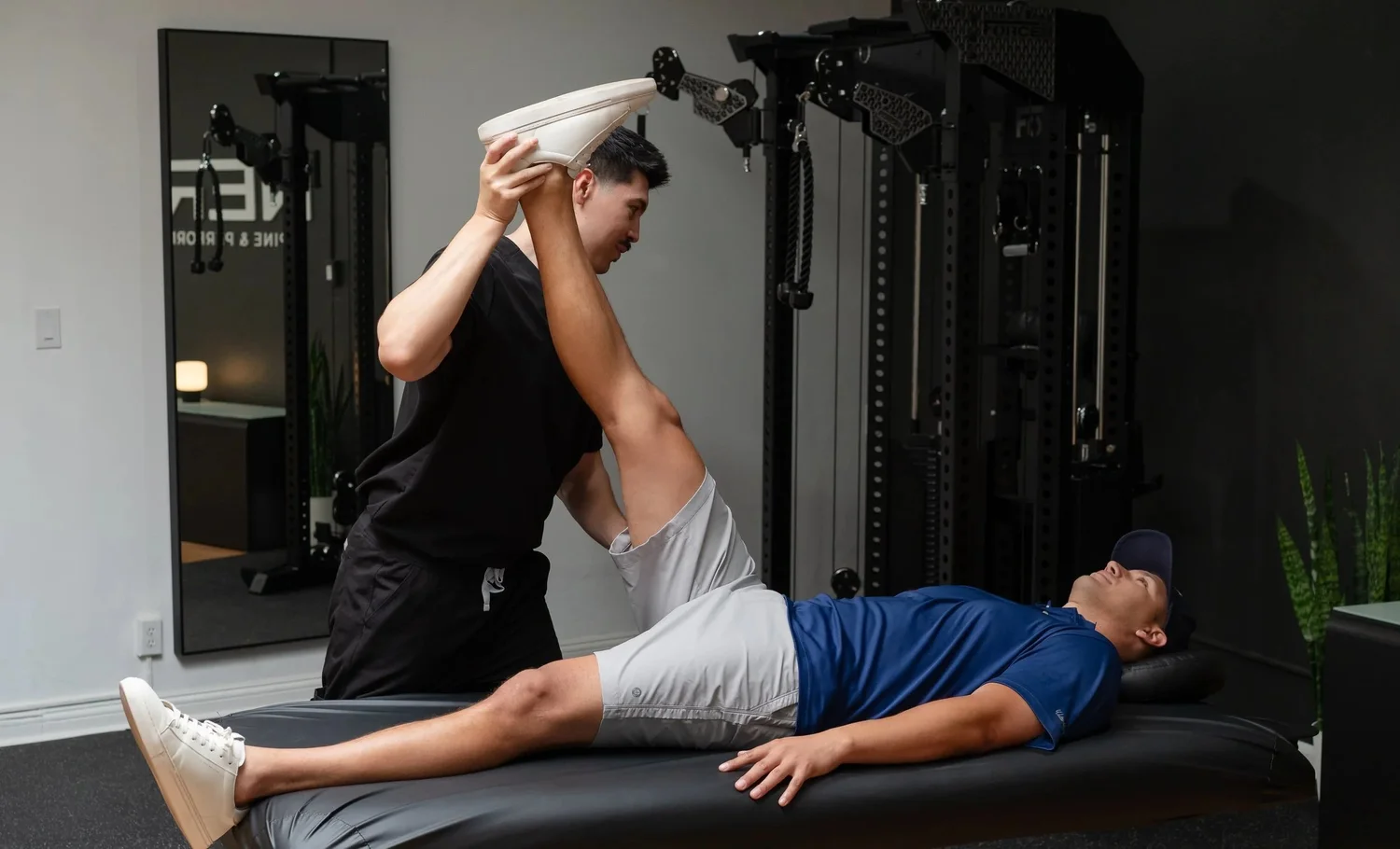
Your first visit is sixty minutes: full history, orthopedic and neurological testing, and hands-on treatment the same day. You will know what is driving your symptoms before you leave.
Book your first visit →5478 Wilshire Blvd, Unit 212 · Los Angeles, CA 90036